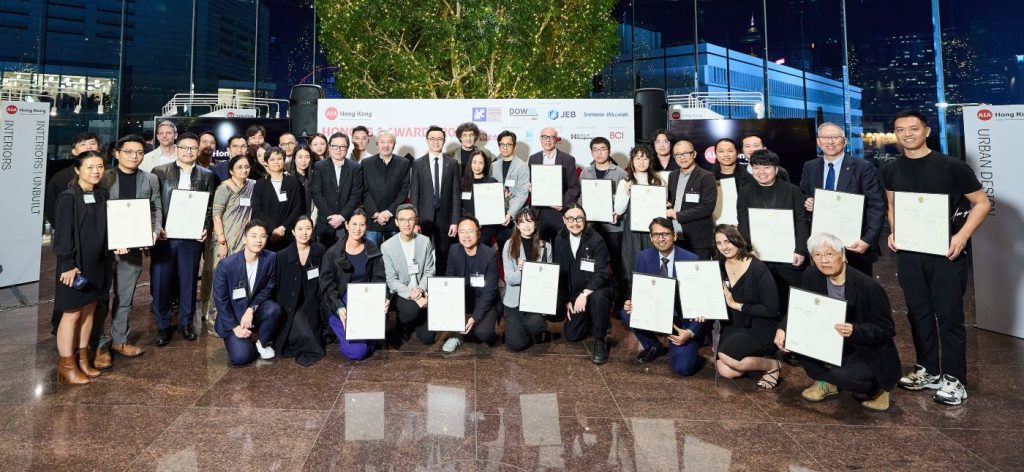
This annual program celebrates outstanding work in architecture, interiors, urban design, and unbuilt projects undertaken by our Chapter’s members and other licensed architects practicing in Hong Kong, China and the Asia Pacific Region. Through these awards, we aim to inspire our community to pursue excellence, champion sustainability, and create a lasting positive impact on the world around us. For the 2024 Honors & Awards program, we are proud to recognize nine outstanding projects that exemplify these values:
Merit Award for Architecture: Qiaochengbei Park Visitor Center – Atelier Xi Society for Community Organization, Transitional Social Housing – Nelson Chen Architects Valley Retreat: Xiaoyou Dongtian – Wang Weijen Architecture Lianzhou Building – Kohn Pedersen Fox
Honor Award for Interiors: Forest House Waldorf School – Index Architecture
Merit Award for Interiors: Shenzhen Metro Line 16 – Matter Design Breathing Home – Su Chang Design Research Office
Merit Award for Unbuilt Projects: POSsible! Public Open Space Design Lab: Design Thinking Toolkit – Architecture Commons
Merit Award for Open International: One Green Mile, Streetscape and Public Space – StudioPOD
Sustainability Award: Qiaochengbei Park Visitor Center – Atelier Xi Society for Community Organization, Transitional Social Housing – Nelson Chen Architects One Green Mile, Streetscape and Public Space – StudioPOD
This year’s Award recipients were selected by a five-person jury panel: – Yung Ho Chang, FAIA , Founding Partner and Principal Architect Atelier Feichang Jianzhu – Barbara Bouza, FAIA, IIDA, Former President of Walt Disney Imagineering – Garth Rockcastle, FAIA, Retired Professor of Architecture – Vivian Ngo, AIA, LEED AP, WELL AP, Design Principal of NBBJ – Lyndon Neri, Founding Partner of Neri&Hu Design and Research Office
When selecting this year’s winners, the five-member jury evaluated entries based on their effective response to project-specific requirements, clear resolution of the program or idea, innovation, technique, and overall excellence in design as reflected by performance addressing one or more of the principles set out in the AIA Framework for Design Excellence (the “AIA Framework”).
Designed to be straightforward and accessible, the AIA Framework has evolved from more than 30 years of effort to harness creative solutions to the global challenges of climate change, booming urbanization, and growing social inequity.
The AIA Framework is built around ten guiding principles: · Design for Integration – Emphasizes the importance of a thoughtful design process that delivers beauty, function, and sustainability in balance. · Design for Equitable Communities – Focuses on ensuring that design solutions positively impact not only the client and current occupants but also future occupants and the larger community. · Design for Ecosystems – Encourages design that is in harmony with natural systems. · Design for Water – Encourages conservation and intelligent management of water resources. · Design for Economy – Advocates for creating economic opportunities that are equitable and sustainable over the long term and for finding cost-effective solutions without compromising design quality or environmental integrity. · Design for Energy – Prioritizes energy efficiency and the use of renewable sources to reduce the environmental impact of buildings and move towards a zero-carbon built environment. · Design for Well-being – Places emphasis on design strategies that promote the health and well-being of occupants. · Design for Resources – Stresses the prudent use and reuse of materials and resources to minimize waste and reduce our carbon footprint. · Design for Change – Supports adaptable designs that can respond flexibly to future needs and challenges. · Design for Discovery – Encourages learning from each project and refining the design process to foster a long-term relationship between designers, users, and operators to ensure that design intentions are realized and building performance continues to improve over time.
|